
The final quarter of the year moves fast. Between October’s Independence Day season, November’s early Black Friday promotions, and December’s Christmas and New Year rush, Q4 is the single busiest commercial stretch most Nigerian businesses experience all year. Foot traffic climbs, competitor promotions intensify, and customers are actively looking for where to spend — which makes this the worst possible time to have faded signage, a burnt-out storefront light, or no seasonal branding at all.
Yet Q4 signage prep is one of the most commonly overlooked parts of year-end business planning. Owners focus heavily on inventory, staffing, and marketing budgets, while the physical signage that actually gets customers through the door is left as an afterthought — patched together at the last minute, or simply left unchanged from the rest of the year.
This guide walks through a complete Q4 signage preparation plan: what to audit, what to fix, what to add, and how to time it all so your business looks its sharpest exactly when the most customers are watching. Whether you’re running a single storefront or managing signage across multiple branches, the framework here scales to your situation.
Many businesses treat signage as a “set it and forget it” investment — install it once, replace it only when it visibly breaks. That approach might be tolerable during a slow quarter, but Q4 changes the math for several reasons.
1. Traffic Volume Amplifies Every Flaw
A cracked lightbox or peeling vinyl decal might go unnoticed by a handful of customers in a quiet month. During Q4’s higher foot traffic, that same flaw is seen by far more people — and first impressions compound quickly when volume is high.
2. Competitors Are Refreshing Too
Nearby businesses are almost certainly updating their own signage for the season — new promotional banners, holiday lighting, refreshed window displays. A storefront that looks static next to visibly refreshed neighbors reads as less active, even if the business inside is thriving.
3. Multiple Overlapping Occasions Need Coordinated Messaging
Q4 isn’t one event — it’s a sequence of them. Independence Day in early October, end-of-year sales pushes in November, Christmas and New Year in December. Signage that’s planned holistically across the quarter, rather than reactively for each occasion, saves money and keeps messaging consistent.
4. Weather Transition Affects Materials
Late Q3 into early Q4 often still carries residual rainy-season conditions in much of Nigeria, transitioning to the harmattan dry season by November and December. Signage installed without accounting for this shift can degrade faster than expected — something worth checking before, not after, the season’s heaviest use.
5. Year-End Budgets Are Being Finalized
For businesses that operate on annual budgets, Q4 is also when unspent marketing or facilities budget often needs to be allocated before year-end. Signage upgrades are a practical, visible way to use remaining budget productively rather than losing it.
Step 1: Conduct a Full Signage Audit
Before deciding what to fix or add, walk your business — literally — and assess everything currently in place.
*Exterior signage checklist:
– Is the main storefront sign clean, properly lit, and free of cracks or fading?
– Are any letters, logos, or panels missing or damaged?
– Is nighttime illumination functioning across all lit elements?
– Are pole signs, pylon signs, or roadside signage still structurally sound after the rainy season?
*Interior signage checklist:
– Are POS (point-of-sale) displays current, or do they reference outdated promotions?
– Is wayfinding signage (restrooms, departments, checkout) still clear and undamaged?
– Are digital displays running current content, or stale loops from months ago?
*Vehicle and mobile signage checklist:
– Are delivery or company vehicle wraps intact, or peeling and faded?
– Do branded vehicles still accurately reflect your current logo, contact details, and offerings?
*Documentation checklist:
– Do you have updated design files for your current signage on hand, in case reprinting or repair is needed quickly?
– Are permits for any existing outdoor signage still valid and up to date?
Walking through this audit in early Q4 — rather than waiting for a customer or staff member to point out a problem — puts you in a position to plan repairs and refreshes proactively rather than reactively.
Step 2: Prioritize Repairs Over Replacements Where Possible
Once the audit is complete, sort issues into two categories: things that need full replacement, and things that can be repaired or refreshed at lower cost. This distinction matters enormously for Q4 budgeting.
*Common repair-vs-replace scenarios:
– Faded vinyl graphics: Often replaceable at the graphic layer without touching the underlying structure — far cheaper than a full sign rebuild.
– Non-functioning illumination: LED modules and transformers can frequently be swapped without replacing the entire lightbox or channel letters.
– Peeling vehicle wraps: Partial re-wrapping of damaged panels is usually more cost-effective than a full vehicle re-wrap, provided the remaining wrap is still in good condition.
– Outdated POS signage: This is a pure reprint job, not a structural repair, and should be one of the cheapest and fastest fixes on your list.
* When full replacement genuinely makes sense:
– Structural rust or corrosion on outdoor sign frames, which poses a safety risk beyond just an aesthetic one.
– Illuminated signage where the housing itself (not just the bulbs) has water damage from the rainy season.
– Signage still displaying an old logo, tagline, or rebrand that no longer matches your current identity.
Getting a signage provider to assess this distinction for you, rather than assuming everything needs full replacement, is one of the most effective ways to control Q4 signage costs while still achieving a meaningfully refreshed look.
Step 3: Plan Layered Seasonal Messaging Across the Quarter
Rather than treating Independence Day, Black Friday, Christmas, and New Year as four separate signage projects, plan them as layers on a consistent base.
*The base layer is your core, non-seasonal branding — your permanent storefront sign, logo, and primary colors. This shouldn’t change quarter to quarter.
*The seasonal layer sits on top of the base — removable banners, window decals, and digital signage content that rotate through October’s patriotic season, November’s promotional push, and December’s festive theme, all while your base branding remains visibly consistent underneath.
This layered approach has two major advantages. First, it’s more cost-effective: you’re paying for smaller, temporary seasonal elements rather than a full signage overhaul four times in a row. Second, it keeps your brand identity recognizable and stable even as the seasonal dressing around it changes — customers should always be able to tell it’s your business, holiday theme or not.
*A practical layering example for Q4:
– Early October: Independence Day window decals and a “green-white-green” accent banner
– Mid-to-late October through November: Transition to “Q4 Sale” or “Black Friday Deals” promotional banners and POS signage
– December: Festive window displays, holiday-themed digital signage content, and a “Happy New Year” transition planned for the final week
Step 4: Time Your Orders to Beat the Rush
Every signage company sees a predictable spike in order volume through Q4, and production timelines lengthen as the season progresses. Planning your order timeline is just as important as planning the designs themselves.
A realistic Q4 signage timeline:
– Early-to-mid September: Complete your signage audit and finalize which repairs, replacements, and seasonal elements are needed for the full quarter.
– Mid-to-late September: Submit design concepts and approvals for Independence Day and general Q4 seasonal signage.
– Early October: Independence Day signage should be installed; place orders for the November promotional layer.
– Early November: November promotional signage installed; place orders for December/Christmas signage.
– Late November to early December: December seasonal signage installed well ahead of the peak shopping weeks.
– Mid-December: Final check and any last-minute touch-ups before the holiday rush peaks.
Businesses that wait until the week before a specific occasion to place signage orders often face longer turnaround times, limited material availability, and rushed design work — all of which are avoidable with a plan that starts in September, exactly the point most businesses are reading a guide like this one.
Step 5: Budget Realistically Across the Quarter
Rather than budgeting for signage as a single Q4 line item, break it down by layer, since each has a different cost profile.
– Repairs and maintenance (fixing existing signage) are typically the smallest cost category but yield an outsized visual improvement, since they address visible flaws rather than adding entirely new elements.
– Reusable seasonal assets (quality banners, vinyl decals designed to last multiple years) cost more upfront but spread their value across future Independence Day, Black Friday, and Christmas seasons, lowering the effective annual cost over time.
– Single-use or highly specific promotional signage (a banner referencing a specific discount percentage or date) should be budgeted as a lower-cost, short-lifespan item, since it isn’t meant for reuse.
– Digital signage content updates are often the cheapest layer of all, provided the hardware is already installed, since only new content — not new materials — is required.
A useful rule of thumb: prioritize spending on whichever layer touches the most customers first. For most storefront businesses, that means exterior and window signage takes budget priority over interior or vehicle signage, simply because it’s what draws people in before they ever reach the counter.
Step 6: Coordinate Signage With Your Broader Q4 Marketing
Signage shouldn’t operate in isolation from your other Q4 marketing efforts. A few ways to tie them together:
– Match your in-store and online promotional messaging. If your social media is promoting a “Q4 Mega Sale,” your storefront and POS signage should use the exact same language and visual style, not a slightly different variant that breaks the continuity.
– Use signage to drive digital engagement. A QR code on a banner or window decal linking to an online promotion page extends the reach of physical signage into your digital channels.
– Brief your staff on the messaging. If a customer asks about a promotion advertised on your signage, staff should be able to speak to it confidently — a disconnect between what signage promises and what staff can deliver undermines the investment.
– Plan takedown alongside your promotional calendar. Signage advertising a specific discount period should come down promptly when that period ends, just as an online ad campaign would be paused, to avoid customer confusion or a sense that the business isn’t keeping its displays current.
Step 7: Don’t Neglect the Basics While Focused on Seasonal Additions
It’s easy to get absorbed in planning exciting new seasonal signage and forget the fundamentals that keep a storefront functional and professional year-round.
– Lighting reliability. With Q4 evenings often busier than usual (later shopping hours, evening events), make sure all illuminated signage is fully functional, not just “mostly working.”
– Cleanliness. Dust and grime accumulated over the year should be cleaned from signage surfaces before the season’s heaviest traffic, since even well-designed signage looks neglected if it’s visibly dirty.
– Safety and stability. Any freestanding or temporary signage — event banners, sidewalk signs, sandwich boards — should be checked for stability, particularly if harmattan winds pick up later in the quarter.
– Accessibility. Make sure new seasonal displays don’t block walkways, entrances, or existing wayfinding signage that customers rely on to navigate your space.
– Starting too late. Waiting until October or November to begin planning means competing with every other business for the same production slots.
– Treating every occasion as a from-scratch project. This inflates costs unnecessarily when a layered approach would achieve the same visual impact for less.
– Ignoring interior signage while focusing only on the storefront. A great exterior draws people in, but stale or missing interior signage weakens the experience once they’re inside.
– Failing to plan takedown. Signage left up well past its relevant season — a “Happy Independence Day” banner still hanging in late November, for instance — signals neglect rather than festivity.
– Underestimating production lead times. Custom or large-format signage often needs more lead time in Q4 than in quieter months, simply due to overall demand across the industry.
– Not budgeting for repairs. Many businesses budget only for new seasonal additions and are caught off guard when existing signage needs unplanned repair mid-quarter.
Consider a business with three locations that decides to prepare for Q4 in early September. The team conducts a signage audit across all locations, finding one branch needs a full lightbox repair, another needs only cleaning and minor decal replacement, and the third is in good structural shape but overdue for a logo update to match a recent rebrand.
Rather than treating each location’s Q4 signage as a separate project, the business works with a single signage provider to standardize a seasonal layering plan — Independence Day decals in early October, a coordinated “Q4 Sale” banner set for November, and Christmas window displays for December — applied consistently across all three branches, with the necessary repairs handled first so the seasonal additions go onto a properly functioning base.
The result is a coordinated, professional look across every location throughout the quarter, achieved through planning that started well before the season’s rush, rather than through last-minute scrambling at each site independently.
While the audit-and-layer framework above applies broadly, different business types tend to prioritize different signage elements during Q4. A closer look at a few common sectors:
*Retail and Fashion. For clothing stores and general retail, Q4 is almost entirely about driving sale-season foot traffic. Window displays, storefront banners, and in-store POS signage should all coordinate tightly around specific promotional dates — Black Friday, Independence Day sales, and Christmas clearance — since retail customers respond strongly to clear, urgent, well-timed messaging. Multi-branch retailers should also prioritize standardizing their promotional signage look across locations, so the campaign feels unified regardless of which branch a customer visits.
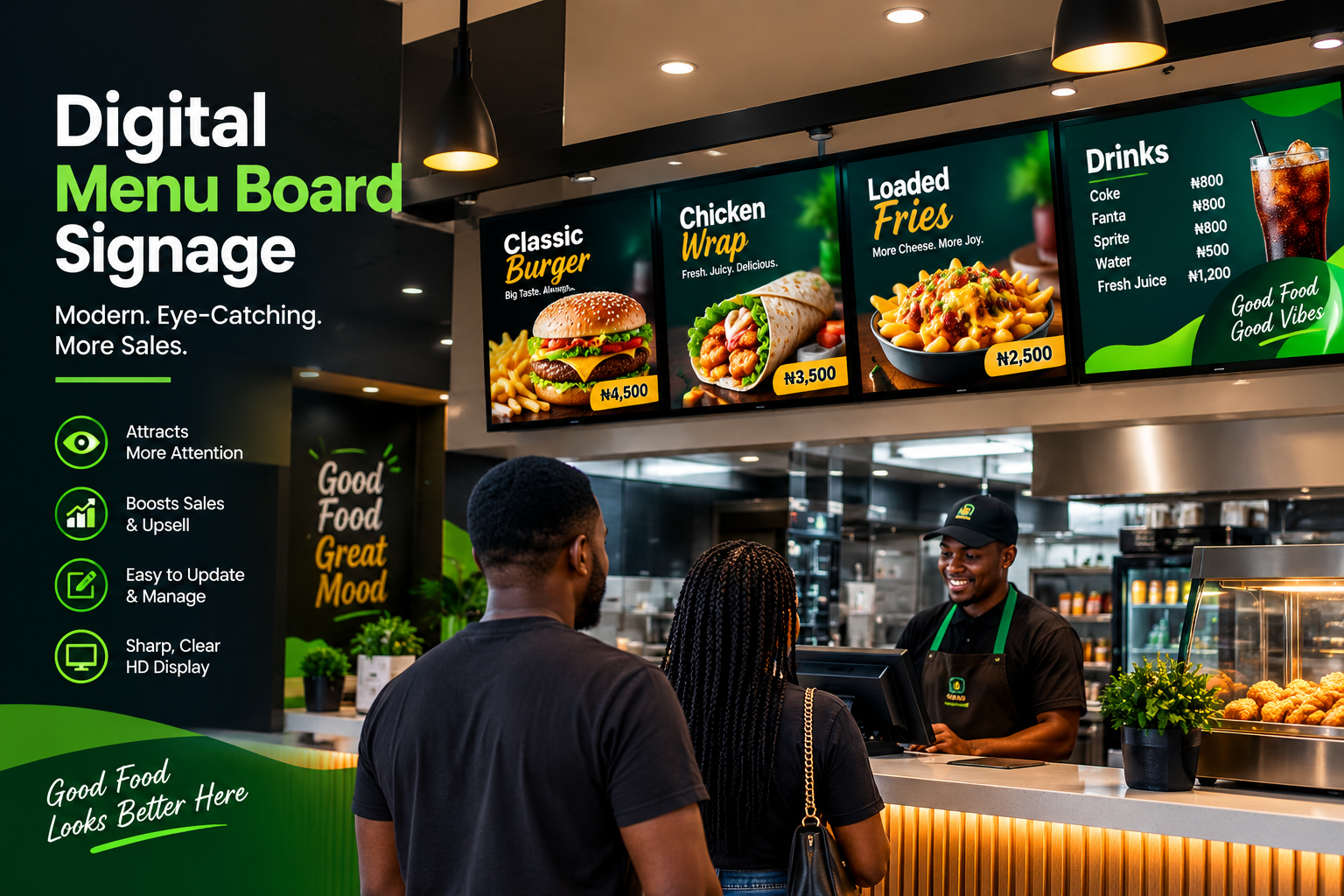
*Hospitality and Food Service. Restaurants, hotels, and cafés benefit from digital menu board updates featuring seasonal specials, festive table and entrance décor for December, and clear signage around any extended holiday operating hours. Guests visiting during Q4 are often celebrating something — a year-end gathering, a holiday meal — and signage that acknowledges the occasion adds to the overall experience in a way that pure discount messaging doesn’t always achieve.
*Corporate and Financial Services. Banks, insurance firms, and professional offices tend to keep Q4 signage understated but should still address the practical side: updated holiday operating hours signage, year-end service announcements, and any lobby displays acknowledging the season. Digital signage in banking halls is particularly useful here since content can rotate through Independence Day, year-end notices, and New Year messaging without any physical reinstallation.
*Real Estate and Property Development. Q4 is often a strong period for property sales as buyers look to finalize purchases before year-end. Roadside signage, show-site banners, and vehicle branding for site visits should be checked and refreshed heading into the quarter, since this is frequently when property developers see their highest inquiry volumes of the year.
*Educational Institutions. Schools wrapping up the academic year often hold end-of-year programs, graduation ceremonies, and holiday events that require their own signage — stage backdrops, directional signage for visiting parents, and recognition banners for graduating students. Because many of these events repeat annually, investing in reusable, well-stored signage elements pays off across multiple future Q4 seasons.
Because Q4 signage often involves a larger combined spend than any other quarter, it’s worth tracking whether that investment is actually paying off, rather than assuming it is based on how good the displays look.
– Compare year-over-year Q4 performance. If foot traffic or sales data is available from previous Q4 periods, compare this year’s numbers against a baseline to see whether the refreshed signage strategy correlates with improved performance.
– Track engagement with QR codes or printed links. Signage that includes a scannable code or short link tied to a specific promotion gives a direct, measurable engagement figure separate from general sales data.
– Monitor which seasonal layer performs best. If your business tracks sales by week, you may notice which occasion — Independence Day, Black Friday, or Christmas — drove the strongest response, which is valuable information for prioritizing next year’s Q4 signage budget.
– Ask new customers how they found you. A simple, informal question at checkout or during onboarding — “what brought you in today?” — can reveal how much influence storefront or promotional signage had, particularly for walk-in customers who aren’t captured by digital analytics.
– Note the cost-per-season of reusable assets. For signage elements built to last multiple years (quality banners, vinyl decals with generic messaging), calculate the cost divided by the number of seasons they’re used across, which usually reveals a much lower effective cost than a single-season view would suggest.
None of this requires sophisticated tools. Even a basic comparison of weekly sales trends against your signage installation timeline can offer a reasonably clear signal of whether the investment is working, and where to adjust for the following year.
Businesses that go through a full Q4 signage prep cycle once often find it far easier the second time around — provided they document what worked. A simple Q4 signage playbook might include:
– A record of what was repaired, replaced, or added each year, along with rough costs, so future budgeting is based on real figures rather than estimates
– Stored design files for reusable seasonal assets, so reordering or reprinting doesn’t require starting the design process from scratch
– A documented timeline showing when each phase (audit, Independence Day layer, promotional layer, festive layer) was completed, to refine timing in future years
– Notes on which signage elements generated the strongest customer response, to guide where next year’s budget should be weighted
Over two or three Q4 cycles, this kind of documentation turns seasonal signage from a recurring scramble into a refined, increasingly efficient process — one where most of the hard planning decisions have already been made, and each year simply requires executing an improved version of the year before.
*How early should Q4 signage planning start?*
Early-to-mid September is the ideal starting point for a full audit and initial planning, allowing time for repairs, design approval, and phased seasonal installations through October, November, and December.
*Should I replace all my signage for Q4, or just refresh parts of it?
In most cases, a mix of targeted repairs and new seasonal layers achieves a strong refreshed look without the cost of full replacement. Full replacement is usually only necessary for structurally damaged or badly outdated signage.
*Can the same signage be reused across Independence Day, Black Friday, and Christmas?*
Not directly, since each occasion has distinct messaging, but a layered approach lets your core branding stay constant while only the seasonal decals or banners rotate, reducing overall cost compared to three unrelated campaigns.
*What’s the biggest signage mistake businesses make in Q4?
Waiting too long to start. Production timelines lengthen industry-wide during Q4, and last-minute orders often mean limited material choices and rushed design work.
*Is digital signage worth adding before Q4 if I don’t already have it?
If budget allows, yes — digital signage offers the most flexibility for rotating through multiple Q4 occasions without needing new physical materials for each one, which can pay off across several future seasons as well.
Preparing signage for a quarter as demanding as Q4 — with multiple overlapping occasions, tight production windows, and businesses across the market all competing for the same signage capacity — requires a partner who can plan ahead, move quickly, and deliver consistent quality across every layer of the job.
SignFix Industrial Limited is built for exactly this kind of seasonal demand:
– Comprehensive audit-to-installation service, meaning your signage repairs, seasonal additions, and full replacements can all be coordinated through one team rather than juggling multiple vendors during your busiest season.
– Experience with Nigeria’s seasonal weather transition, ensuring signage installed heading into Q4 is built to handle the shift from residual rainy-season conditions into the harmattan dry season without premature wear.
– Layered campaign planning expertise, helping businesses design a base-plus-seasonal signage strategy that stays cost-effective across Independence Day, Black Friday, and Christmas rather than treating each as an isolated expense.
– Reliable turnaround during peak demand periods, which matters enormously when every business in your area is placing signage orders at the same time.
– Multi-location coordination capability, so businesses with several branches can maintain a consistent, professional look across every site throughout the quarter.
– A track record across retail, hospitality, corporate, and event signage, meaning the guidance you receive is tailored to your specific business type rather than generic recommendations.
Q4 rewards businesses that plan ahead — and signage is one of the most visible, highest-impact ways to show customers your business is active, current, and ready for the season. That’s the difference SignFix Industrial Limited brings to every Q4 signage project.
Ready to get your signage Q4-ready before the rush begins? Reach out to the SignFix Industrial Limited team today for a full audit and a phased plan covering Independence Day, Black Friday, and Christmas.
Contact us at: support@signfix.ng or info@signfix.ng or Call us: +234 903 336 6660