

Industrial environments are among the most high-risk working spaces in the world. From manufacturing plants and warehouses to construction sites and oil refineries, workers are constantly exposed to potential hazards such as heavy machinery, electrical systems, chemical exposure, and moving equipment.
In such environments, communication is not optional—it is a matter of life and death.
This is where Industrial Safety Signage plays a critical role.
Safety signage is a universal visual communication system designed to alert, guide, and protect workers and visitors in industrial environments. It ensures that everyone understands hazards, follows safety protocols, and responds correctly in emergencies.
Without proper safety signage, workplaces become chaotic, unsafe, and legally non-compliant.
This blog explores everything you need to know about industrial safety signage, including its importance, types, standards, design principles, implementation process, and future trends.
Industrial safety signage refers to the use of standardized visual symbols, colors, text, and shapes placed within industrial environments to communicate safety information.
It includes warnings, instructions, prohibitions, emergency guidance, and mandatory actions.
The primary purpose is to:
* Prevent workplace accidents
* Protect workers and visitors
* Communicate hazards clearly
* Ensure regulatory compliance
* Improve emergency response
1. Prevents Workplace Accidents
Clear warning signs reduce the risk of injuries caused by machinery, chemicals, and hazardous zones.
2. Saves Lives in Emergencies
Emergency exit signs and evacuation routes guide people safely during fires, explosions, or disasters.
3. Ensures Legal Compliance
Most countries require industrial facilities to follow occupational safety standards.
4. Improves Operational Efficiency
Workers move confidently when they understand their environment.
5. Reduces Liability Risks
Proper signage reduces legal exposure for companies in case of accidents.
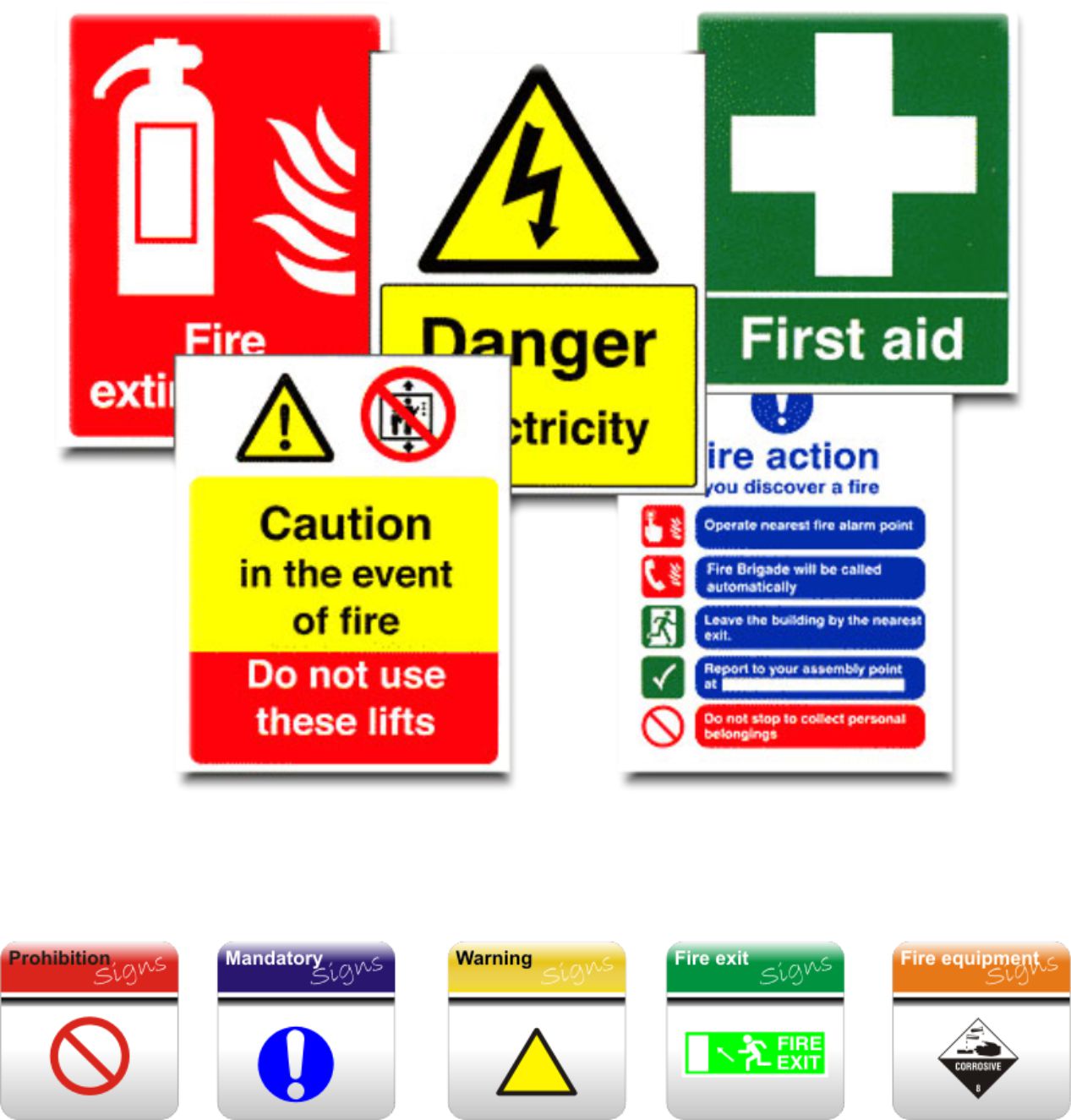
Industrial safety signage is categorized based on function and meaning.
1. Warning Signs
These signs alert workers to potential hazards.
Examples:
* High voltage areas
* Slippery floors
* Heavy machinery zones
* Toxic chemical storage
Color: Yellow with black symbols
2. Prohibition Signs
These signs indicate actions that are not allowed.
Examples:
* No smoking
* No entry
* No open flames
* No unauthorized access
Color: Red circle with diagonal line
3. Mandatory Signs
These signs instruct workers on actions they must take.
Examples:
* Wear safety helmet
* Use protective gloves
* Wear eye protection
* Use ear protection
Color: Blue background
4. Emergency Signs
These guide people during emergencies.
Examples:
* Emergency exit
* First aid station
* Fire extinguisher location
* Assembly points
Color: Green background
5. Fire Safety Signs
These identify fire equipment locations.
Examples:
* Fire alarm
* Fire extinguisher
* Fire hose reel
Color: Red background
6. Informational Signs
These provide general guidance.
Examples:
* Directional arrows
* Facility maps
* Department labels
Safety signage must comply with international and national standards.
Key Standards Include:
* ISO 7010 (Safety symbols standardization)
* OSHA regulations (Occupational Safety and Health Administration)
* ANSI Z535 (Safety sign design system)
* Local industrial safety codes
These standards ensure consistency, readability, and universal understanding.
Design Principles of Effective Safety Signage
1. Clarity
Messages must be simple and instantly understandable.
2. Visibility
Signs must be visible from a safe distance.
3. Consistency
Use uniform colors, fonts, and symbols.
4. Durability
Materials must withstand industrial conditions such as heat, dust, and chemicals.
5. Universality
Symbols should be understood regardless of language.
6. Strategic Placement
Signs must be placed exactly where decisions are made.
Industrial environments require durable materials.
Common materials include:
* Aluminum sheets
* Acrylic panels
* PVC boards
* Reflective vinyl
* Stainless steel
* Photoluminescent materials (glow-in-the-dark)
1. Manufacturing Plants
To guide machine operation safety and hazard zones.
2. Construction Sites
To warn about falling objects, restricted zones, and PPE requirements.
3. Oil and Gas Facilities
To indicate explosive zones and emergency protocols.
4. Warehouses and Logistics Centers
To manage vehicle movement and loading safety.
5. Chemical Industries
To label hazardous substances and storage rules.
6. Electrical Installations
To prevent electrocution risks.
Safety signage is designed based on human behavioral psychology.
Key principles include:
* Color recognition triggers instant reaction
* Symbols bypass language barriers
* Repetition improves memory retention
* Placement influences decision-making
The human brain processes visual warnings faster than written instructions, making signage a critical safety tool.
1. Poor Placement
Signs hidden behind machinery or obstacles are ineffective.
2. Inconsistent Design
Mixed symbols and colors create confusion.
3. Faded or Damaged Signs
Old signs lose visibility and effectiveness.
4. Overcrowding
Too many signs reduce attention and clarity.
5. Lack of Maintenance
Safety signage must be regularly inspected and replaced.
* Reduced workplace accidents
* Improved compliance with safety laws
* Faster emergency response
* Increased employee confidence
* Better risk management
* Lower operational downtime
Modern industries are adopting smart safety systems.
1. Digital Warning Displays
LED screens showing real-time hazards.
2. Sensor-Based Alerts
Machines trigger warnings when risks are detected.
3. QR Code Safety Instructions
Workers scan codes for safety manuals.
4. Augmented Reality Training
AR systems simulate safety environments for training.
Step 1: Risk Assessment
Identify hazards in the environment.
Step 2: Compliance Review
Ensure adherence to safety regulations.
Step 3: Site Mapping
Identify key decision points for signage placement.
Step 4: Design Development
Create signage layouts and symbols.
Step 5: Material Selection
Choose durable and appropriate materials.
Step 6: Production
Manufacture signage with precision.
Step 7: Installation
Install signs at strategic locations.
Step 8: Monitoring
Regular inspection and updates.
1. Smart Safety Systems
AI-driven hazard detection and alerts.
2. Fully Integrated IoT Safety Networks
Connected industrial environments.
3. Sustainable Materials
Eco-friendly signage production.
4. Multilingual Digital Signage
Real-time translation systems for global workforces.
When it comes to industrial safety signage, precision, durability, and compliance are non-negotiable.
SignFix Industrial Limited is a trusted leader in delivering high-quality industrial signage solutions designed to meet strict safety standards and withstand harsh industrial environments.
Here’s why SignFix Industrial Limited stands out:
* Expertise in industrial safety communication systems
* Compliance with international safety standards such as ISO and OSHA principles
* Use of durable, high-performance materials suitable for industrial conditions
* Custom safety signage solutions tailored to specific industry needs
* Advanced production technology ensuring clarity and long-lasting visibility
* End-to-end service from risk assessment to installation
* Proven experience across manufacturing, construction, and oil & gas sectors
Choosing SignFix Industrial Limited means choosing safety, compliance, and reliability without compromise.
Industrial safety signage is not just a regulatory requirement—it is a fundamental part of workplace safety culture. It protects lives, prevents accidents, and ensures smooth industrial operations.
In an environment where every second and every decision matters, clear visual communication can make the difference between safety and disaster.
Organizations that invest in professional safety signage systems are not only complying with regulations—they are building safer, more efficient, and more responsible workplaces.
Contact Us at support@signfix.ng or info@signfix.ng or Call Us +234 903 336 6660