In today’s fast-growing commercial and corporate environments, the ability for people to navigate spaces efficiently has become more than just a convenience—it is a necessity. Whether it is a multinational corporate headquarters, a hospital complex, a shopping mall, or an industrial estate, clear navigation plays a vital role in shaping user experience, operational efficiency, and even brand perception.
This is where Corporate Wayfinding Solutions come in.
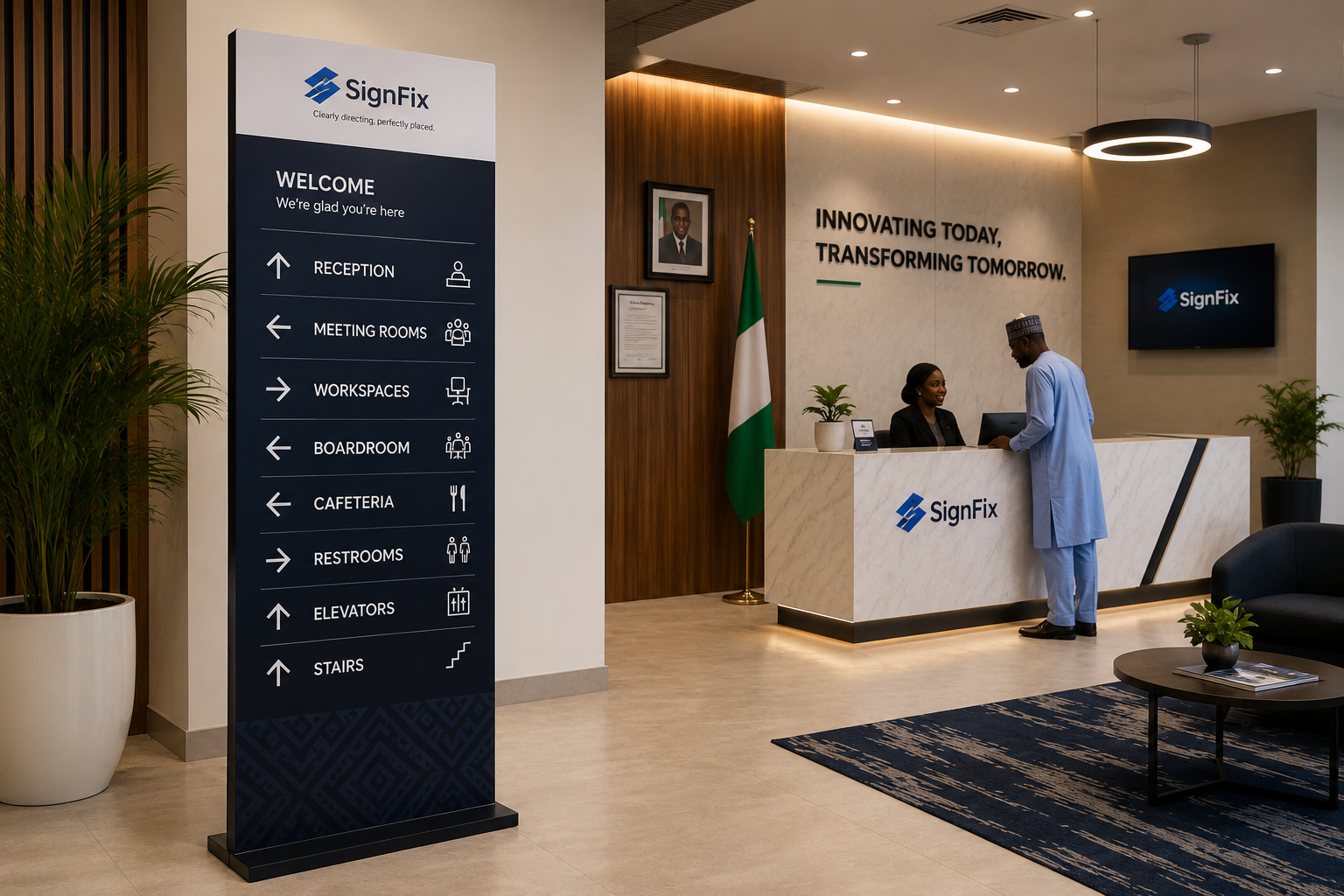
Wayfinding is not just about signs on walls or arrows pointing directions. It is a complete strategic communication system that integrates design, psychology, architecture, branding, and technology to guide people through physical environments seamlessly.
Businesses that invest in well-designed wayfinding systems reduce confusion, improve customer satisfaction, increase safety, and elevate their brand identity. In contrast, poorly designed navigation systems create frustration, inefficiency, missed opportunities, and even safety risks.
This comprehensive guide explores everything you need to know about corporate wayfinding solutions—from principles and benefits to design strategies, implementation steps, and industry applications.
Corporate wayfinding refers to the system of visual cues, signage, maps, symbols, lighting, and digital interfaces used within corporate and commercial environments to help people navigate spaces effectively.
It is a combination of:
* Architectural design integration
* Visual communication
* Environmental psychology
* Branding and identity systems
* User experience (UX) strategy
* Signage engineering
A successful wayfinding system ensures that anyone, whether a visitor, employee, or contractor, can move from point A to point B without confusion or assistance.
1. Enhances User Experience
The first impression of any corporate environment is often shaped by how easy it is to navigate. Visitors who can easily find their destination feel more comfortable and confident in the space.
2. Strengthens Brand Identity
Wayfinding systems are not just functional—they are also branding tools. Colors, typography, materials, and design language can all reflect corporate identity.
3. Improves Operational Efficiency
Employees and visitors waste less time asking for directions or getting lost. This leads to improved productivity and smoother operations.
4. Increases Safety
Clear evacuation routes, emergency exits, and directional signage are critical in emergency situations.
5. Reduces Staff Burden
Receptionists and staff spend less time giving directions, allowing them to focus on more important tasks.
A complete corporate wayfinding system is made up of several interconnected components:
1. Identification Signage
These signs identify rooms, departments, offices, and zones.
2. Directional Signage
Arrows and guides that help people move through spaces.
3. Informational Signage
Provides general information such as floor directories, maps, and instructions.
4. Regulatory Signage
Includes safety instructions, restrictions, and compliance notices.
5. Architectural Integration
Built-in signage elements that blend with interior design.
6. Digital Wayfinding
Interactive screens, mobile apps, QR codes, and AR-based navigation systems.
To create a successful wayfinding system, several design principles must be followed:
1. Clarity
Messages must be simple, direct, and easy to understand.
2. Consistency
Fonts, colors, symbols, and styles must remain uniform across all signage.
3. Visibility
Signs must be placed in highly visible locations with proper lighting.
4. Hierarchy
Important information should stand out more than secondary details.
5. Accessibility
Wayfinding must accommodate people with disabilities, including visual and mobility impairments.
6. Predictability
Users should be able to anticipate where signs will appear.
1. Corporate Offices
Large office buildings require clear departmental navigation and meeting room identification.
2. Shopping Malls
Customers need assistance locating stores, restrooms, exits, and entertainment areas.
3. Hospitals and Healthcare Facilities
Wayfinding is critical in reducing stress for patients and visitors.
4. Educational Institutions
Universities and schools require campus-wide navigation systems.
5. Industrial Complexes
Factories and warehouses need safety and operational direction signage.
6. Hotels and Hospitality Spaces
Guests rely heavily on signage to navigate rooms, amenities, and facilities.
Wayfinding is deeply connected to human psychology. People naturally rely on visual cues to make spatial decisions.
Key psychological factors include:
* Cognitive mapping (mental mapping of environments)
* Decision points (locations where users choose directions)
* Environmental cues (colors, lighting, textures)
* Memory retention (familiar patterns improve navigation)
A well-designed system reduces cognitive load, meaning users don’t need to think hard to navigate.
Modern businesses now use wayfinding systems as an extension of their branding strategy.
Brand Elements in Wayfinding:
* Corporate color schemes
* Typography consistency
* Logo placement
* Material selection (glass, metal, acrylic, wood)
* Tone of communication
A strong integration ensures that even directional signs reinforce brand identity.
Technology is reshaping corporate navigation systems.
1. Interactive Digital Maps
Installed in lobbies and major intersections.
2. Mobile Wayfinding Apps
Allow users to navigate buildings using smartphones.
3. QR Code Navigation
Users scan codes to get directions instantly.
4. Augmented Reality (AR) Wayfinding
Overlays directions onto real-world environments.
5. Smart Building Integration
IoT-enabled systems that adapt signage based on usage patterns.
Despite its benefits, implementing a wayfinding system comes with challenges:
1. Poor Planning
Lack of architectural integration leads to confusion.
2. Inconsistent Design
Mixed signage styles reduce clarity.
3. Budget Constraints
High-quality systems require investment.
4. Space Limitations
Older buildings may not support modern systems easily.
5. Maintenance Issues
Signs must be regularly updated and maintained.
Step 1: Site Analysis
Understand the building layout, traffic flow, and user behavior.
Step 2: User Journey Mapping
Identify how visitors move through the space.
Step 3: Strategy Development
Define signage types, placement, and design system.
Step 4: Design Phase
Create visual mockups and prototypes.
Step 5: Material Selection
Choose durable and visually appropriate materials.
Step 6: Production
Manufacture signage using high-quality standards.
Step 7: Installation
Place signage strategically across the environment.
Step 8: Evaluation and Optimization
Monitor effectiveness and make adjustments if needed.
* Aluminum composites
* Acrylic panels
* Stainless steel
* Vinyl graphics
* LED illuminated panels
* Glass engraving
* Wood laminates
Each material serves different environmental and branding purposes.
* Improved customer satisfaction
* Reduced confusion and complaints
* Enhanced brand professionalism
* Increased safety compliance
* Better space utilization
* Higher operational efficiency
1. AI-Powered Navigation Systems
Artificial intelligence will adapt navigation based on user behavior.
2. Sustainable Signage Materials
Eco-friendly materials will become standard.
3. Fully Digital Buildings
Physical signage may combine with fully digital interfaces.
4. Voice-Activated Navigation
Users may soon ask buildings for directions verbally.
When it comes to delivering world-class corporate wayfinding solutions, experience, precision, and creativity matter.
SignFix Industrial Limited stands out as a leading force in the signage and visual communication industry. The company specializes in delivering high-quality, innovative, and durable signage solutions tailored to corporate environments, commercial complexes, and industrial facilities.
Here’s why SignFix Industrial Limited is the ideal choice:
* Expertise in corporate signage systems backed by years of industry experience
* High-quality material production ensuring durability and premium finish
* Custom design approach tailored to each client’s brand identity
* Modern manufacturing technology for precision and consistency
* End-to-end service delivery from consultation to installation
* Strong understanding of environmental branding and UX flow
* Proven track record across corporate, retail, and industrial projects
Choosing SignFix Industrial Limited means choosing clarity, professionalism, and brand excellence in every step of your wayfinding system.
Corporate Wayfinding Solutions are no longer optional in modern business environments—they are essential. From improving user experience to strengthening brand identity and ensuring safety, wayfinding systems play a critical role in how people interact with physical spaces.
Businesses that invest in strategic wayfinding design not only improve functionality but also elevate their overall brand perception and operational efficiency.
As corporate environments continue to grow in complexity, the demand for intelligent, integrated, and visually compelling wayfinding systems will only increase.
Contact Us at support@signfix.ng or info@signfix.ng or Call Us +234 903 336 6660


How to Design Promotions Customers Can’t Ignore End-of-year sales are
Every year, as October 1st approaches, Nigeria comes alive in